AURORA Mission X
Learn through
the landing.
An educational Flutter and Flame simulator with 14 configured stages, Gemini guidance and a separate Q-learning demonstration.
AURORA Mission X
An educational Flutter and Flame simulator with 14 configured stages, Gemini guidance and a separate Q-learning demonstration.
01 · Control
The lander mechanics include thrust, rotation, fuel, wind and hazards. Choices change the descent.
02 · Feedback
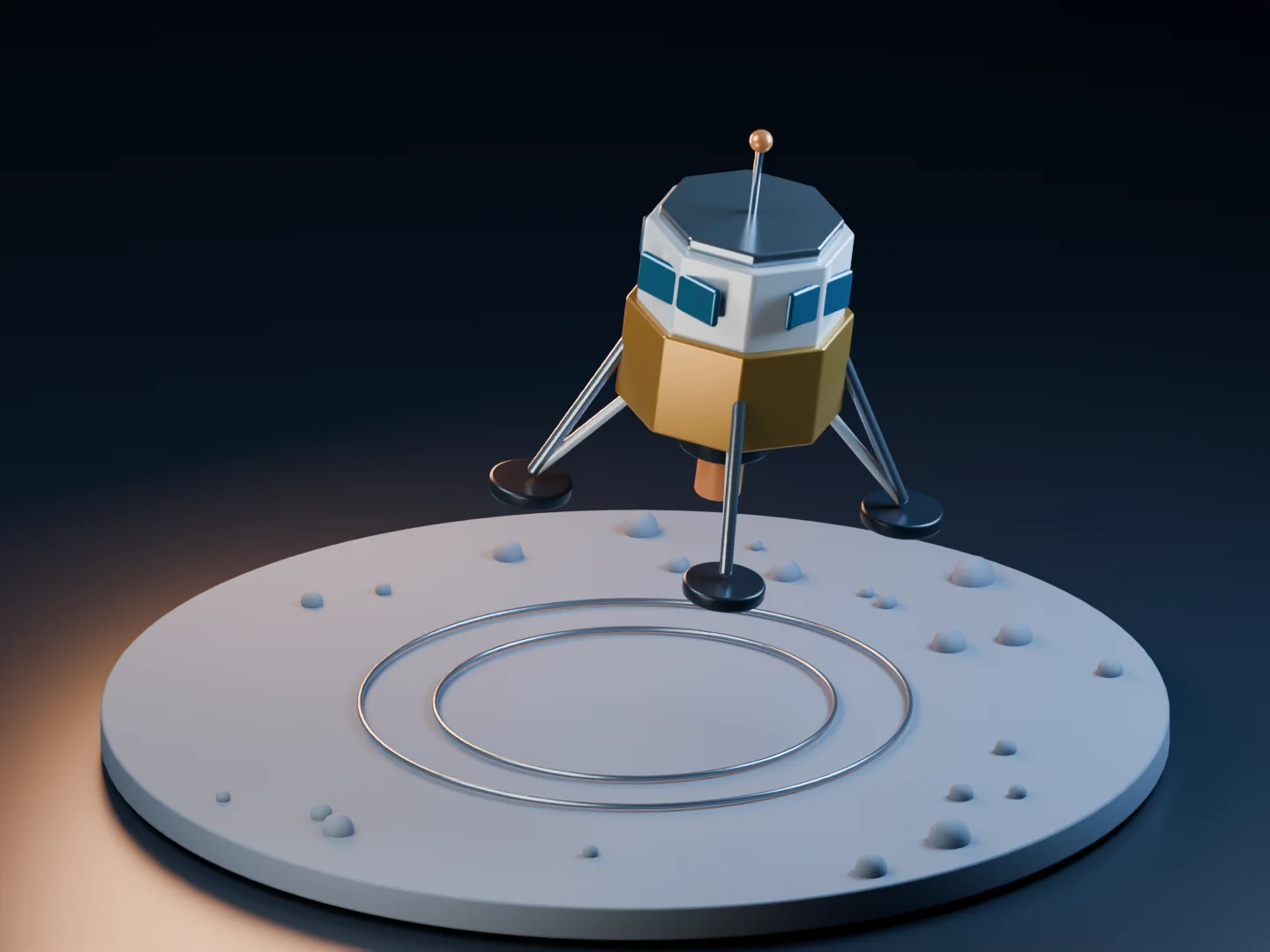
Gemini guidance is integrated into the learning experience. This new spacecraft render illustrates the idea rather than reproducing gameplay.
03 · Learn
The main game’s AI controller uses PD control. A separate interactive demonstration explains tabular Q-learning.
04 · Project scope
Built with Hoor Salman. AR was experimental and disabled in the inspected version; no validated success-rate claim is made.
Team challenge project · October-November 2025
Learning about landing through play and feedback.
01 / Purpose
Create an educational space-landing experience for the SpaceAware Application Challenge.
02 / Approach
Flutter and Flame power the application and lander mechanics, with 14 configured stages and Gemini guidance. A separate interactive demonstration implements tabular Q-learning in JavaScript.
03 / Contribution
Team project credited to Husain Altelly and Hoor Salman. The repository records both contributors; it does not establish a precise division of every implementation task.
04 / Demonstration
The lander supports thrust, rotation, fuel, wind, and hazards. Its main AI controller uses proportional-derivative control; the separate Q-learning demo should not be confused with a trained policy controlling the main game.
05 / Results
The source supports a 14-stage simulator, Gemini integration, and an interactive learning demonstration. The project received third place in the SpaceAware Application Challenge according to the consistent CV and LinkedIn accounts.
06 / Limitations
AR was experimental and disabled in the inspected version. Static training-theater data does not establish a validated success rate or training run count. The interactive Q-learning demonstration and main-game controller have different roles.
07 / Lessons learned
An educational interface needs to distinguish a demonstration, a working feature, and an experiment clearly. That distinction is especially useful when explaining what an AI component actually does.
Next project
Blender visuals explain the projects. Balancing-robot geometry, the planning environment, Flowra interface and AURORA lander are original illustrative concepts made for this portfolio. Their movement, example text and layouts are not recorded results, original course CAD, production screenshots or gameplay.
The T42 scene uses Yale OpenHand Model T42 CAD from the OpenHand repository, licensed CC BY-NC 3.0. The assembly, materials, actuator housings, tendon path and deformation are illustrative. Cast contact materials are not reconstructed.
R. R. Ma, L. U. Odhner, A. M. Dollar, “A Modular, Open-Source 3D Printed Underactuated Hand,” ICRA 2013.
The Yale OpenHand Project is an initiative to advance the design and use of robotic hands designed and built through rapid-prototyping techniques in order to encourage more variation and innovation in mechanical hardware. Please visit the Yale OpenHand site for more details.
