Model T42 robotic gripper
Two fingers.
A careful grip.
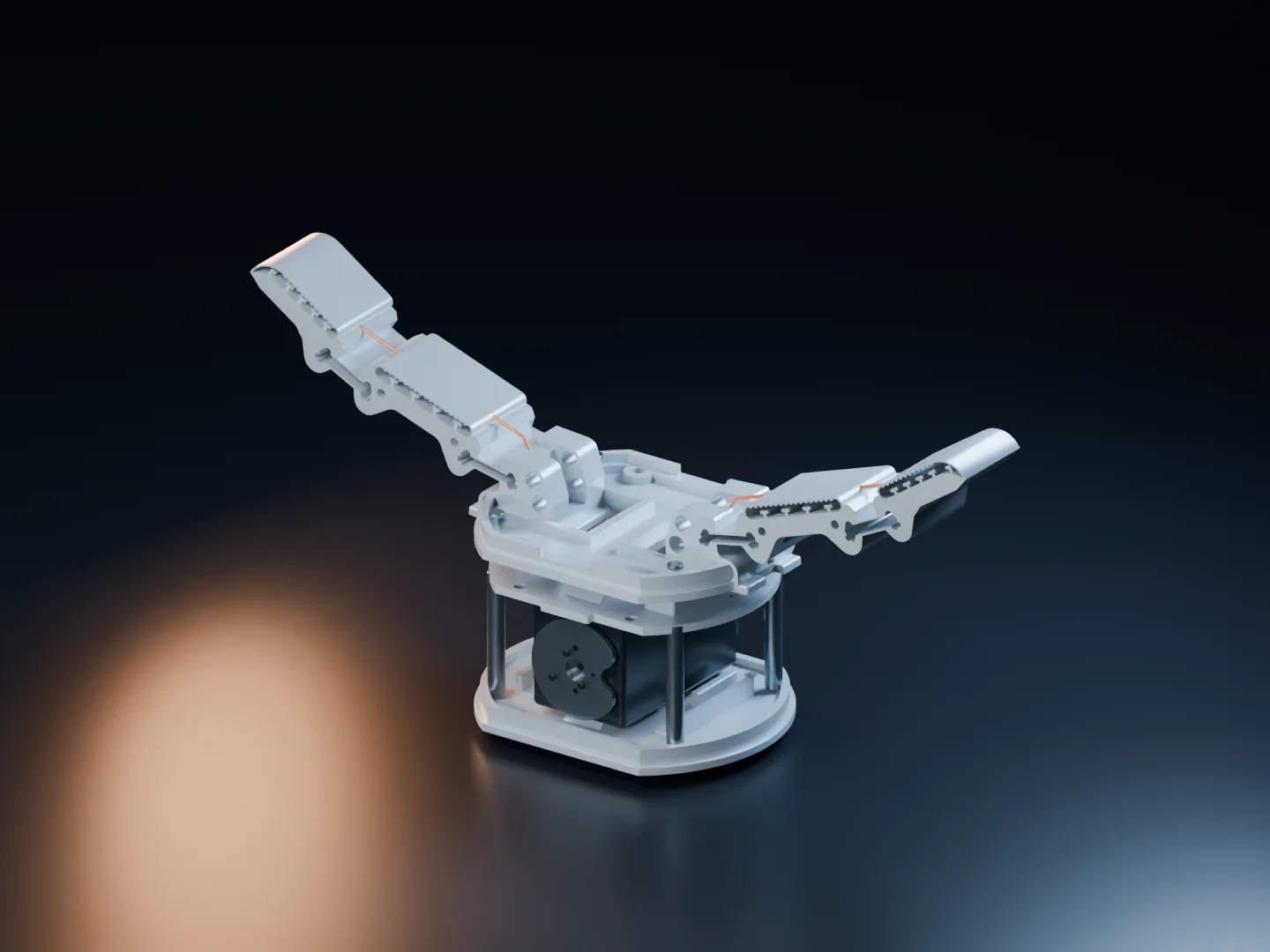
Our team implemented the Yale OpenHand T42: an underactuated gripper built around tendon-driven fingers.
Model T42 robotic gripper
Our team implemented the Yale OpenHand T42: an underactuated gripper built around tendon-driven fingers.
01 · The mechanism
The existing OpenHand platform gave us a mechanical foundation to assemble, analyze and understand.
02 · Motion, made visible
Actuators pull the tendons. The fingers flex. This animated study makes that relationship easier to see.
03 · Look inside
The frame brings the fingers and actuators together. The layers separate here to reveal the assembly.
04 · Beyond the render
Our course work connected MATLAB analysis with assembly, motor communication and calibration.
Team course project · ROBO 204 · May 2026
Understanding a grasp, from the mechanism to the motor.
01 / Purpose
Implement and understand the Yale OpenHand Model T42 gripper, an existing tendon-driven platform. The platform design belongs to the Yale OpenHand project.
02 / Approach
The team used MATLAB analysis, assembled printed components and tendon-driven fingers, and worked with Arduino and Dynamixel control. Testing covered motor communication, calibration, speed synchronization, opening and closing, and basic grasping.


03 / Contribution
Team project with Husain Altelly, Mohammed Muqeet, Obaid Alaleeli, and Ibrahim Alhammadi. The report supports a shared implementation credit; it does not reliably divide individual tasks.
04 / Demonstration
The report documents tendon routing and the assembled gripper. The visualization uses original Yale OpenHand fabrication CAD with presentation materials, simplified actuator housings, an illustrative tendon path and approximate finger deformation. Cast contact materials are not reconstructed. It is not a validated simulation or manufacturing reference.
05 / Results
The report documents assembly, calibration, and basic grasping tests. It does not establish a new gripper design or independently reproduced force and reliability benchmarks.
06 / Limitations
Tendon routing and calibration affect finger movement. Quantitative grasp-force, payload, and endurance results should not be claimed without measurements.
07 / Lessons learned
Working from an established mechanism makes calibration, mechanical assembly, and communication between the controller and actuators central engineering tasks.
Next project
Blender visuals explain the projects. Balancing-robot geometry, the planning environment, Flowra interface and AURORA lander are original illustrative concepts made for this portfolio. Their movement, example text and layouts are not recorded results, original course CAD, production screenshots or gameplay.
The T42 scene uses Yale OpenHand Model T42 CAD from the OpenHand repository, licensed CC BY-NC 3.0. The assembly, materials, actuator housings, tendon path and deformation are illustrative. Cast contact materials are not reconstructed.
R. R. Ma, L. U. Odhner, A. M. Dollar, “A Modular, Open-Source 3D Printed Underactuated Hand,” ICRA 2013.
The Yale OpenHand Project is an initiative to advance the design and use of robotic hands designed and built through rapid-prototyping techniques in order to encourage more variation and innovation in mechanical hardware. Please visit the Yale OpenHand site for more details.